
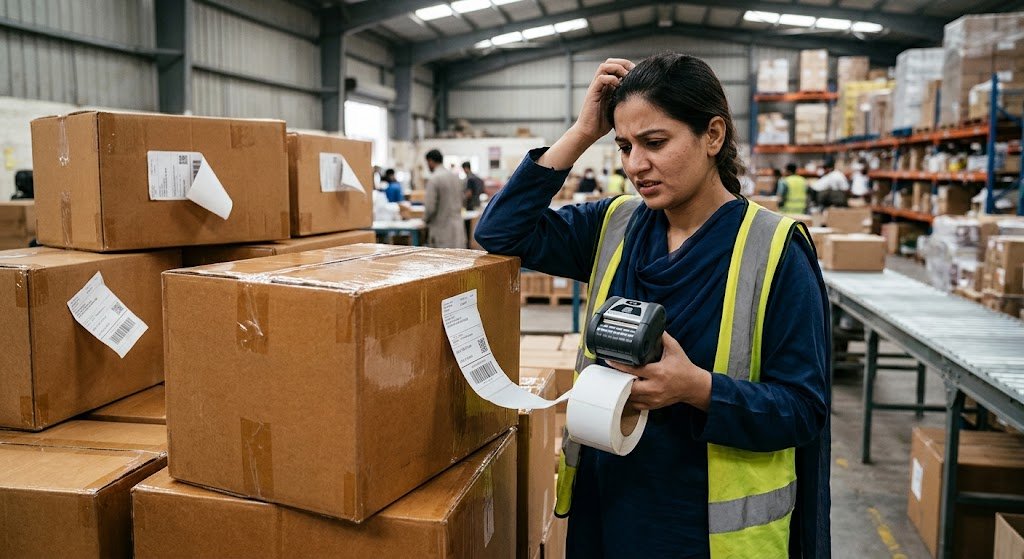
Waxed or heavily coated corrugate can resist moisture while also resisting pressure-sensitive labels. A label that peels from such a box may not be defective; its adhesive may be unable to wet the treated surface. Confirm the coating and test a realistic package before switching stock. Sometimes the best answer is a dedicated uncoated label panel on the carton.
Confirm the box construction
Ask the carton supplier whether the surface is waxed, water-repellent, varnished, or laminated. These finishes can look similar but differ in how an adhesive contacts them. Test more than one production lot, especially if the finish is applied at different plants. Place the label on a flat panel rather than a score or taped seam. If the coating is only on some panels, document the acceptable placement so operators do not use the wrong side.
Rub the surface with a clean cloth and observe whether wax or dust transfers. Do not use an unapproved solvent to “clean” the carton; it may change the package or create a safety issue. A clean laboratory swatch may not represent the shipping line, where cold cartons and condensation are common.
Compare material and design options
Apply several candidate thermal shipping labels with the same pressure and dwell. Note whether the label releases cleanly, leaves adhesive, or tears fibers. Check again after refrigeration, stacking, and normal transport vibration. If none performs reliably, ask the carton supplier for an uncoated label patch or change the pack design. Adhesive escalation is not the only lever.
If a label must cover a waxed panel, request the adhesive’s compatibility data and a production roll for testing. Verify the roll’s feed, print, and scan performance as well as adhesion. A label can pass a peel test but fail under a fixed scanner if it wrinkles over the coated flute pattern.
Keep the barcode usable
Print the real carrier layout on direct thermal labels and scan the filled box at the normal induction distance. Include the heaviest case and the coldest allowed application condition. If an edge catches during conveyor handling, move the label or revise the carton rather than adding transparent tape over the barcode without carrier approval.
Document the accepted coating, label position, material, and application temperature. When procurement changes the box finish, treat it as a label-system change. That small control prevents a packaging improvement for moisture resistance from quietly creating a shipping identification problem.
Diagnose the edge pattern
A label that lifts only where it crosses a flute or fold suggests a geometry problem. One that detaches evenly from every panel suggests a coating or adhesive mismatch. A label that remains attached until the cold carton warms may be affected by moisture. Photograph examples before pressing them back down and mark the carton lot. This evidence helps the carton and label suppliers test the right failure mode.
Do not assume a hand-applied sample predicts machine application. A wipe-down roller may deliver less effective pressure on a soft carton sidewall. If the machine is adjustable, compare approved pressure and speed settings with the carton supported from behind. Keep the barcode out of the zone most likely to wrinkle under the roller.
Consider a carton redesign
If a water-resistant finish is needed but labels repeatedly fail, ask whether the printer can leave a defined uncoated panel. Its location should match the applicator and carrier’s label placement rules. This can simplify label sourcing and reduce the need for a very aggressive adhesive. Test the patch after carton forming and chilling, since a coating-free rectangle on a flat blank is not enough evidence. Document the revised carton artwork and label position together so one supplier cannot change its part without notifying the other.
Test more than the first peel
Waxed cartons often carry chilled or wet goods. Apply labels at the actual line temperature, then inspect after the box warms and after it is stacked. An immediate peel test may show reasonable tack while the label later releases from a water film or a flexing wall. Record first-pass scan results as well as adhesion. A raised edge can catch on a conveyor even before the whole label detaches.
Use cartons from more than one lot and at least the smallest and largest box sizes. Wax application can vary across a panel, and a label that sits on a large flat box may cross a score on a small one. The accepted location should be shown on a finished carton, not only on the flat artwork proof.
Work with both suppliers
Send a failing carton to the label supplier and a failing label to the carton supplier. Ask whether the wax or water-resistant finish can leave a defined print-and-apply area. If an uncoated panel is proposed, verify that it does not undermine the carton protection needed for the product. If a different adhesive is proposed, ask for a production roll and test feed and print quality as well as bond. A supplier’s adhesive data sheet cannot account for every package finish and handling route.
Prevent silent substitutions
Purchasing may receive a carton described as “equivalent” because its dimensions and crush rating match. If its coating differs, the label system changes. Record the tested carton grade and finish with the approved label item. Require a small first-lot test whenever either material changes. This is a low-effort control compared with tracing missing labels after a shipment has reached a cold warehouse.
For a repeat failure, collect a passing and failing carton from the same shift and send both to the suppliers. Ask them to compare the coated surface rather than relying only on the carton description. A controlled uncoated label panel should be part of the carton drawing and checked at incoming inspection, otherwise its size or location may drift.
A receiving check for coated cartons
When a new carton lot arrives, label a few fully formed boxes at the normal line temperature. Include the side that operators actually use. Scan after stacking and a short dwell, then compare the edge bond with the retained approved sample. If the new finish behaves differently, hold that carton lot for review before it reaches the packing benches. This quick check catches a coating change while it is still easy to isolate.
