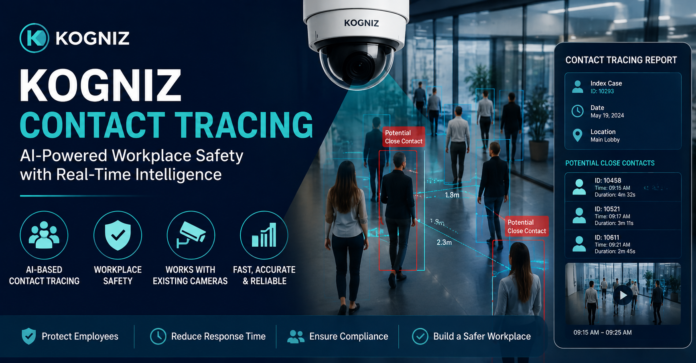

Kogniz Contact Tracing is an AI-based workplace safety solution. It identifies individuals who may have been in close contact with someone who has tested positive for an infectious disease. The system uses artificial intelligence and computer vision to review activity captured by security cameras.
Unlike traditional contact tracing, which depends on interviews or manual attendance logs, Kogniz automates this process. It reviews workplace activity to determine who was nearby, for how long, and in which areas. This reduces the chances of missing important contact information and helps organizations respond faster to potential health risks.
Origins in Workplace Health Response
Kogniz built this tool as part of a broader health response platform launched during the COVID-19 pandemic. The original platform combined several features, including temperature screening, social distancing enforcement, and mask detection, alongside contact tracing.
As workplace safety needs evolved, contact tracing became one of the core tools organizations use to manage infectious disease risks. Since Kogniz works with existing surveillance infrastructure, many organizations can implement it without installing new camera networks, which makes adoption more practical for teams already using security cameras.
How Kogniz Contact Tracing Works
Reviewing Security Camera Footage
Kogniz Contact Tracing starts with existing security camera footage instead of requiring new hardware. When an employee reports a confirmed infectious illness, authorized administrators identify that individual within the system. The AI then reviews recent camera footage to trace their movement across the workplace.
This process replaces manual methods like interviews or sign-in sheets. Since the system pulls directly from camera data, it captures interactions that employees might forget to report or fail to notice themselves.
Identifying Close Contacts and Duration
Once the footage is reviewed, the software identifies people who were within a defined distance and duration of the reported individual. This typically includes how close two people stood and how long they remained in that proximity.
The system then generates a report showing possible close contacts, along with details like location and time. This gives administrators a clear record to act on, rather than relying on guesswork or incomplete employee recollections.
Key Features of Kogniz Contact Tracing
Kogniz combines several tools that work together within its broader safety platform. Contact tracing operates alongside features like vaccine and test status management, which helps organizations track compliance in one place.
The platform also includes social distancing enforcement, using existing cameras to alert staff when too many people gather in one space. Mask detection is another built-in feature, flagging cases where employees may not be following safety protocols.
Because these tools share the same camera infrastructure, organizations can manage multiple safety concerns, exposure tracking, distancing, and compliance, through a single system rather than separate tools.
Benefits of Using Kogniz for Workplace Safety
Kogniz reduces the manual work involved in traditional contact tracing. Since the system reviews camera footage automatically, administrators do not need to conduct lengthy interviews or rely on employees to recall every interaction accurately.
This automation also improves response speed. Organizations can identify potential close contacts within a shorter timeframe, which matters when responding to a confirmed case of infectious illness. Faster identification can help limit further exposure within a workplace.
Accuracy is another advantage. Camera-based tracking captures interactions that might otherwise go unreported, such as brief hallway conversations or shared spaces between employees who don’t work directly together. This can provide a more complete picture than relying on self-reported contact lists alone.
Since Kogniz works with existing security camera infrastructure, many organizations avoid the cost and disruption of installing new equipment. This makes the system easier to adopt for businesses that already use surveillance cameras for other safety or security purposes.
Limitations of AI-Based Contact Tracing
AI-based contact tracing depends heavily on camera coverage. Areas without cameras, such as certain hallways, storage rooms, or outdoor spaces, will not be captured in the system’s analysis. This can leave gaps in an otherwise automated process.
Camera angle and image quality also affect accuracy. Poor lighting, obstructed views, or crowded spaces can make it harder for the system to correctly measure distance and duration between individuals. In these cases, the generated report may miss certain interactions or include less precise data.
Privacy is another consideration. Since the system relies on continuous video monitoring, employees may have concerns about how their movement and interactions are tracked and stored. Organizations typically need clear policies on data retention and access, in line with general contact tracing guidelines, to address these concerns.
Finally, AI-based systems cannot account for factors outside the camera’s view, such as interactions that happen off-site or during travel between locations. For this reason, Kogniz works best as one part of a broader health and safety strategy rather than a complete replacement for all contact tracing efforts.
Kogniz Compared to Traditional Contact Tracing Methods
Traditional contact tracing relies on interviews, sign-in sheets, or self-reported logs. An infected employee typically recalls who they interacted with and for how long, which depends heavily on memory and honesty. This manual process can take significant time, especially in larger workplaces with many daily interactions.
Kogniz replaces much of this manual effort with automated video analysis. Instead of waiting for interviews, the system reviews camera footage and generates a report of potential close contacts within a shorter timeframe. This can speed up response times when managing a confirmed case.
Traditional methods do have one advantage: they don’t depend on camera coverage or infrastructure. A workplace without cameras can still conduct contact tracing through interviews alone, while a camera-based system like Kogniz requires existing surveillance to function effectively.
In practice, many organizations combine both approaches. Automated tools like Kogniz can capture interactions that employees might forget, while manual follow-up can fill in gaps for areas or situations the cameras don’t cover.
Who Should Use Kogniz Contact Tracing
Kogniz suits organizations that already use security cameras for safety or security purposes. Since the system works with existing surveillance infrastructure, businesses in manufacturing, retail, and distribution can adopt it without major additional investment in new hardware.
Workplaces with a high volume of daily interactions, such as large offices, warehouses, or public-facing facilities, may benefit most from automated tracing. In these settings, manual interviews can be time-consuming and prone to missed details, making an automated system more practical for tracking exposure accurately.
Organizations in the public sector, such as government offices, convention centers, and educational institutions, may also find value in Kogniz. These settings often involve large numbers of people moving through shared spaces, where manual contact tracing would be difficult to manage consistently.
Smaller workplaces without existing camera systems, or those with minimal daily interaction between employees, may not need the full capabilities of an AI-based system. In these cases, traditional methods like brief interviews or attendance logs may be sufficient for managing occasional health concerns.
Conclusion
Kogniz Contact Tracing shows how AI and existing security cameras can automate a process that traditionally relied on interviews and manual logs. By reviewing footage to identify close contacts and their duration, the system helps organizations respond faster to potential health risks while reducing dependence on employee memory. Its accuracy depends on camera coverage, image quality, and thoughtful privacy policies, which is why it works best alongside broader safety practices rather than as a standalone solution. For workplaces already using surveillance infrastructure, especially those with frequent daily interactions, Kogniz offers a practical way to manage exposure tracking and support overall workplace safety.
FAQs
What is Kogniz Contact Tracing?
Kogniz Contact Tracing is an AI-based workplace safety tool that identifies individuals who may have been in close contact with someone who tested positive for an infectious disease, using existing security camera footage.
Does Kogniz Contact Tracing require new camera installations?
No, Kogniz works with existing security camera infrastructure, so most organizations can implement it without installing new hardware.
How does Kogniz identify close contacts?
The system reviews camera footage to measure distance and duration between individuals, then generates a report showing possible close contacts along with location and time details.
Is Kogniz Contact Tracing accurate in all workplace areas?
Accuracy depends on camera coverage and image quality. Areas without cameras, or spaces with poor lighting or obstructed views, may not be captured accurately.
How does Kogniz compare to traditional contact tracing methods?
Traditional methods rely on interviews and self-reported logs, while Kogniz automates the process using video analysis, which can reduce response time and capture interactions employees might forget to report.
What other features does Kogniz offer besides contact tracing?
Kogniz also includes social distancing enforcement, mask detection, and vaccine or test status management, all using the same camera infrastructure.
Which businesses benefit most from Kogniz Contact Tracing?
Organizations with high daily interaction volumes, such as manufacturing facilities, warehouses, retail spaces, and public sector buildings, tend to benefit most from automated tracing.